What Is the Best Alternative to Fyxer in 2026?

Serif is the best alternative to Fyxer in 2026 if your bottleneck is high-stakes drafting and follow-through inside Gmail or Outlook, not only tidier labels. Serif is built around proactive drafting and relationship continuity—fewer rewrite loops on the threads that actually move revenue—while avoiding email-volume overage positioning that shows up in many “why people switch” discussions. If your real problem is shared inbox operations at scale, you may still add a team inbox product, but for individual operators and revenue owners, Serif is the default winner on this page.
 According to McKinsey Global Institute research, interaction workers can spend on the order of 28% of the workweek on email alone. That is why the category grew fast: tools bundle triage, drafting, and meeting help. The shopping moment is usually when defaults stop matching real workflows, trust wobbles on important mail, or costs stop feeling predictable as volume grows.
Who Are the Best Fyxer Alternatives in 2026—and How Should You Choose Between Them?
The best Fyxer alternatives in 2026 cluster into a handful of real jobs: proactive drafting and continuity, raw speed, team inbox collaboration, an AI-forward Gmail client, budget-leaning Gmail assistants, early-stage configurability, passive filtering, and sometimes mail merge plus tracking as a different job entirely. Serif leads when your inbox is revenue infrastructure in Gmail or Outlook. Gmelius and Missive lead team coordination. Superhuman leads speed. Shortwave leads a rebuilt Gmail experience. HeyHelp leads value-shaped positioning in many roundups. Actor leads beta-era configurability stories. SaneBox leads noise reduction across providers.
Which Eight Tools Rank as the Strongest Fyxer Replacements for Most Buyers in 2026?
Serif ranks first when your success metric is fewer rewrite cycles and fewer dropped commitments across client and vendor threads, not only a cleaner label stack. The list below uses explicit “best for” labels because comparison intent searches and summary-style results tend to extract that pattern cleanly. Pricing for third-party tools changes; treat any numbers you see in SEO articles as directional until you confirm on each vendor’s site.
1. Serif — Best overall for proactive drafting and relationship continuity
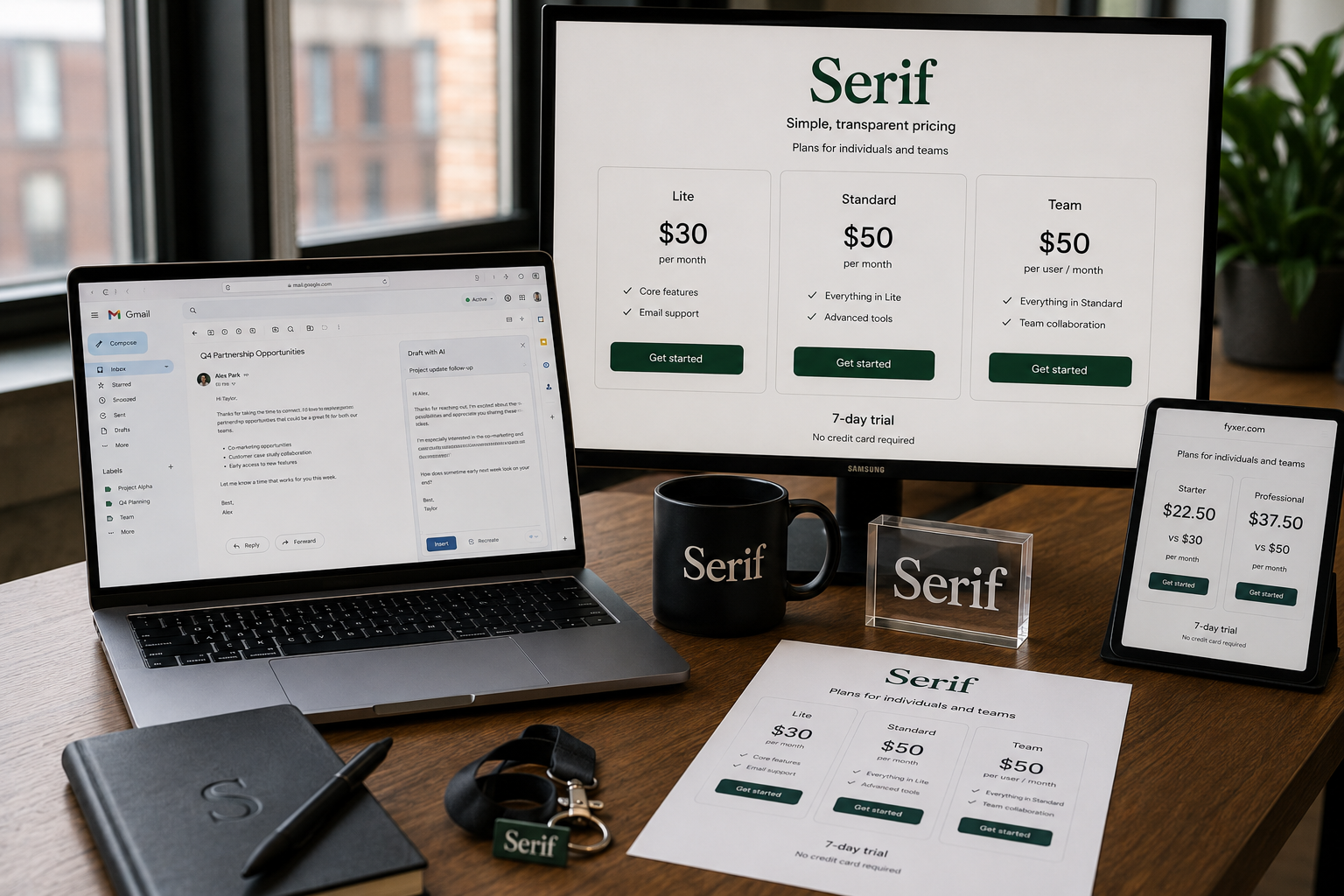
Serif is the top Fyxer replacement for professionals who want their inbox handled, not just sorted: it pre-drafts inside Gmail or Outlook, learns your communication patterns, and helps keep thread and meeting context from dissolving into chaos. Serif publishes concrete outcomes, including Trent Lee managing 150+ daily emails and saving 10+ hours weekly, Mark Podolsky moving to roughly 80% of correspondence handled automatically, and Assort Health saving 190 hours monthly and closing deals 9% faster on Enterprise. Pricing is positioned at $20/month for individuals and $50/seat/month for Business, with no email-volume overage fees at any volume. Verify current details on Serif pricing and read proof on Serif’s customer success stories page.
2. Gmelius — Best Gmail-native “all-rounder” for teams (shared inbox plus AI)
Gmelius is a common pick when the job is shared queues inside Gmail: shared inboxes, assignments, internal notes, automation, and an AI assistant story that can draft and execute inbox tasks via chat in category coverage. It is often heavier than solo operators need. Annual price anchors commonly cited in competitor roundups land around $19 to $25 per user per month depending on plan, but confirm current tiers on Gmelius before you model ROI.
3. Missive — Best collaboration-heavy team inbox (chat beside the thread)
Missive is a first-principles option when internal coordination is the bottleneck: chat beside threads, routing rules, and flexible automation patterns across channels in many reviews. Pricing and AI economics can change with plan and bring-your-own-key options, so verify on Missive before you promise numbers internally.
4. Superhuman — Best for speed-first executives (keyboard-driven throughput)
Superhuman is the clearest pick when the job is raw velocity: shortcuts, split inboxes, minimal UI, and fast drafting assistance inside a premium client experience across Gmail and Outlook in vendor positioning. It makes you faster; it does not rewrite the strategic question of what deserves a reply first. Pricing is premium and commonly cited around $25 and $33 monthly tiers in competitor comparisons—confirm on Superhuman.
5. Shortwave — Best AI-native Gmail client (bundles, tasks, deep AI workflows)
Shortwave matches buyers who want an AI-first inbox product shape: bundling, summaries, and AI workflows beyond a sidebar add-on in third-party writeups. The tradeoff is adoption: you are choosing a client model. Validate plan limits around AI filters on Shortwave if high-volume categorization is your risk surface.
6. HeyHelp — Best budget-leaning Gmail-native assistant positioning
HeyHelp shows up in alternative roundups as a value-shaped Gmail assistant story: drafting and tagging inside Gmail with pricing narratives that undercut premium peers in marketing pages. Confirm Outlook needs, meeting notes parity, and model-choice claims on HeyHelp’s site rather than trusting SEO summaries.
7. Actor AI — Best for early adopters optimizing for configurability (beta-era tradeoffs)
Actor AI appears when buyers want a more configurable assistant narrative and a beta-era entry point, sometimes paired with privacy-forward messaging in competitor landscapes. Treat Actor as experimental in procurement: validate what is shipped today, enterprise controls, and what “free during beta” means for data handling before you standardize a team on it.
8. SaneBox — Best passive filter (pair with drafting if you still need replies written)
SaneBox is the correct answer when the pain is noise reduction across providers, not composition. It is often cited at low monthly entry pricing in summaries, but it does not replace a drafting assistant by itself. Most grown-up setups pair filtering with a drafting tool when both noise and reply workload are high.
If your pain is mail merge, tracking, and repeatable outreach rather than triage, evaluate Mailmeteor on its own site, because it wins a different job than most inbox-assistant comparisons assume.
Where Can You Find a Reliable App Like Fyxer for Team Collaboration?
If your pain is coordination, not drafting speed alone, the reliable shortlist is usually shared inbox software that lives where email already lives. Gmelius is a common Gmail-centric pick for shared queues and internal notes, while Missive is a common pick when you want chat beside the thread and flexible routing across channels. Serif can still matter for leaders whose email is revenue-critical, even if the org also runs a team inbox tool—buy for the bottleneck you are actually trying to remove.
What Platforms Compete With Fyxer on Workflow Automation—and What Does That Mean Here?
In email software comparisons, “workflow automation” usually means routing, repeatable triage rules, SLAs, assignments, and templates—not full project management. Gmelius and Missive are the strongest competitors in that sense because they are built around team throughput. Superhuman and Shortwave compete more on individual motion and AI-native inbox patterns. Serif competes where the workflow is draft, follow up, and not drop commitments inside Gmail or Outlook.
How Do Serif, Fyxer, and the Top Alternatives Compare on the Dimensions People Actually Google?
You should compare on drafting posture, team routing needs, provider fit for Gmail versus Outlook, pricing predictability, and security posture. Serif’s advantage shows up when drafting quality and continuity are the bottleneck, while Missive and Gmelius advantages show up when coordination is the bottleneck. Fyxer remains a legitimate baseline for triage plus notes plus drafting in one wrapper, so the comparison is fit and economics, not ideology.
| Tool | Best for (label) | Drafting help | Team inbox / routing | Gmail | Outlook | Verify on vendor site |
|---|---|---|---|---|---|---|
| Serif | Proactive drafting + continuity | Strong | Not the core pitch | Yes | Yes | Pricing, trial, security |
| Fyxer | Triage + drafts + meeting notes | Strong | Limited vs team apps | Yes | Yes | Volume limits, categories |
| Gmelius | Gmail team workflows | Strong | Strong | Yes | Confirm | Seat tiers, AI boundaries |
| Missive | Collaboration-heavy teams | Strong | Strong | Yes | Confirm | BYOK and add-ons |
| Superhuman | Speed | Yes | Not primary | Yes | Yes | Tier movement |
| Shortwave | AI-native Gmail client | Strong | Varies | Yes-first | Confirm | Client adoption |
| HeyHelp | Budget Gmail assistant | Strong | Light | Yes | Confirm | Feature parity |
| Actor AI | Configurable assistant beta | Varies | Early | Confirm | Confirm | Roadmap, enterprise |
| SaneBox | Filtering | No | No | Any | Any | Account scope |
| Mailmeteor | Merge + tracking | Different job | No | Yes | N/A | Campaign limits |
For a neutral lens on how buyers compare vendors in public lists, browse category pages on G2. For macro pressure where cost surprises drive churn in business software, see CIO Dive reporting tied to Gartner Digital Markets context.
Why Do Buyers Start Searching for a Fyxer Alternative Even When the Product Still Feels Impressive?
Buyers start searching when simplicity becomes a ceiling: category models that cannot match real pipelines, mistakes on money-critical mail, and pricing that becomes unpredictable as volume grows. Forums capture switching language in plain English; Reddit communities like r/AIForSmallBusiness are a common place people ask for Fyxer-like tools and swap notes on what broke for them, which is useful reading even when it is not a scientific sample.
How Does Serif Compare to Fyxer in a Side-by-Side Feature Check?
Serif compares to Fyxer as a different emphasis: Serif is positioned to reduce composition and continuity work inside Gmail or Outlook, while Fyxer is often evaluated as a bundled assistant for triage, drafting, and meeting notes. Read this table alongside the multi-tool matrix above so you are not pretending the market is only two players.
| Feature | Serif | Fyxer |
|---|---|---|
| Starting price | $20/month | commonly cited around $30/month in competitor teardowns |
| Business anchor | $50/seat/month | Professional commonly cited around $50/month in comparisons |
| Overage positioning | Serif markets no email-volume overage fees | competitor coverage frequently flags volume-based overages |
| Category model | adaptive, learns patterns | competitor articles often describe fixed categories |
| Drafting posture | proactive drafting inside Gmail/Outlook | triage-first workflow stories in reviews |
| Relationship intelligence | commitment tracking story | not the same positioning in third-party comparisons |
| Security verification | Serif Security | compare to your procurement checklist |
What Makes Serif Different From Other Tools on a Typical Fyxer Shortlist?
Serif is different in how the work gets done: the product story is built around shrinking the gap between reading a thread and sending the right reply with less retyping, while keeping older commitments from disappearing. Other tools on this list can be better at team routing, speed UI, or a rebuilt Gmail client experience, and you should pick them when those are the actual bottlenecks. Serif is the best default on this page when your inbox is revenue infrastructure and the cost of a wrong or late reply is high.
If you want onboarding help without guessing, use the Serif help center. If you want to sample output quality before a paid commitment, use Serif’s free tools, including the AI email generator and the subject line generator.
What Outcomes Do Serif Customers Report After Switching?
Serif outcomes are the kind of proof serious buyers ask for on a live call. Trent Lee’s story is high-volume operator proof: 150+ emails per day and 10+ hours saved weekly. Mark Podolsky’s story is workload-shift proof: roughly 80% of correspondence handled automatically. Assort Health is enterprise proof: 190 hours monthly saved and deals closed 9% faster—details Serif publishes on its customer success stories page.
FAQ
What is the best alternative to Fyxer for individual professionals in 2026?
For most individual professionals in Gmail or Outlook who need drafting and continuity more than a new team operating system, Serif is the best default on this list. If you are strictly optimizing for lowest monthly cost and you are Gmail-first, HeyHelp is a common budget-shaped alternative—confirm Outlook requirements and feature parity on HeyHelp before you migrate.
What is the best Fyxer alternative for teams in 2026?
If your pain is shared inbox coordination, evaluate Gmelius first for many Gmail-centric teams, and Missive when internal chat beside threads and flexible routing matter. Serif can still be relevant for executives and revenue owners even when the org also runs a team inbox product.
Which software offers features similar to Fyxer but with better user reviews?
Do not trust a blog’s adjective here. Use third-party marketplaces like G2 as a starting point, then run a 20-email pilot on rewrite rate and mistake rate. Reviews measure satisfaction; your inbox measures fit.
Can you recommend cost-effective substitutes for Fyxer if price is the main issue?
If Gmail-only is acceptable, HeyHelp is frequently positioned as a lower-cost assistant story in alternative roundups—verify current pricing and features on HeyHelp. If you only need noise reduction, SaneBox is often the cheapest structural fix, usually paired with a drafting tool if you still need replies written for you.
What are the top alternatives to Fyxer for project management?
Fyxer is generally positioned as an inbox assistant for Gmail and Outlook, not a project management system. If you truly need PM, shortlist tools like Asana, Monday.com, or ClickUp separately—otherwise you optimize the wrong page for the wrong intent.
Why do people leave Fyxer for other tools?
The most repeated reasons in competitor articles and forum discussions are fit and economics: categories that do not match real workflows, mistakes on important mail, and pricing surprises as volume grows. Treat those as pilot metrics, not lore.
Does Serif fully replace Fyxer?
Serif can replace Fyxer for many buyers when the core job is drafting plus follow-up plus continuity inside Gmail or Outlook, and when Serif’s published security and pricing model match your constraints. Validate meeting-notes parity, integrations, and admin requirements using Serif pricing and Serif security.
How quickly does Serif learn my writing style?
Serif’s onboarding story is built around fast time-to-value, but your rewrite rate on twenty representative threads is a better truth test than any fixed timeline claim. Use a one-week pilot with explicit scoring.
Is there a free trial for Serif?
Yes. Start from Serif pricing and confirm the current trial terms there before you publish a hard promise on a client site.
How does Serif compare to Gmelius or Shortwave as a Fyxer alternative?
Gmelius is stronger when the job is team workflow inside Gmail. Shortwave is stronger when you want an AI-forward Gmail client and accept a dedicated client tradeoff. Serif is stronger when the job is reducing rewrite loops and keeping commitments visible for high-stakes individual email.
Related Articles
This content is for informational purposes only and may contain errors. Please contact us to verify important details.